
Devir
Berlin 1960
Berlin 1960
Couldn't load pickup availability
Cold War tensions run high as spies, double agents, and informants move unseen through the divided city. Trust no one, outwit and uncover your enemies in this game of hidden roles and deception for a large group of daring players. In this game set in the German capital during the Cold War, you’ll assume the identity of a member of the CIA or the KGB. Throughout the game, you’ll use various powers to try to identify your fellow agents and hinder your rivals’ investigations and communications. However, every action counts, and the signals you send to your allies may be misinterpreted.
The embers of World War II were still warm when the Cold War began to intensify between the Soviet bloc and the Western powers. One of the main fronts of this “war-non-war” was the streets of Berlin, where the conflict wasn’t fought with tanks or bombs, but with clandestine meetings and secret agents. As political turmoil in Germany escalated, the world’s leading intelligence agencies, the CIA and the KGB, clashed in the city’s streets, clubs, and meeting rooms.
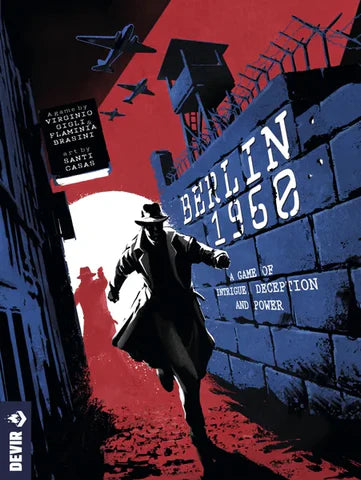
This is the setting for Berlin 1960, a game designed by Virginio Gigli and Flaminia Brasini, authors of Coimbra, Lorenzo il Magnifico or Grand Austria Hotel (the latter two with Simone Luciani), with illustrations by Santi Casas. Players take on the roles of espionage chiefs who must manage their agents to carry out secret missions that advance their organization’s interests while trying to keep their identities safe and uncover the enemy’s infiltrators to thwart their plans. At the end of this grim secret war, only one agency will emerge victorious.
As is typical of Devir’s own-published games, the design and selection of game components have been meticulously crafted to bring Cold War Berlin to life and transport players back to the 1960s. The setup includes a main game board, where the most important events take place, and several individual agent boards for each player, along with a substantial deck of 88 spy cards in eight different colors and a total of 90 mission cards, divided equally between the CIA and the KGB.
The management of secret information relies on affiliation cards that determine each player’s side and a list of accusations to identify enemies. The set is completed with various markers for tracking semesters, victory points, and turn order, as well as 20 shooting tokens that represent direct risks to agents and limit their operational capacity during the game.
The dynamics of a game of Berlin 1960 are an exercise in deduction and clandestine operations that unfolds over three semesters. At the start, each player secretly receives their affiliation (CIA or KGB) but is unaware of their allies, creating an atmosphere of constant suspicion. Each round begins with the spy assignment phase, where players simultaneously choose a card from their hand and place it face down on their board. During individual turns, players reveal their spy to activate their special ability or perform basic actions, such as stealing or playing missions for either of the two agencies represented on the sides of the board. A semester ends when one of the agencies receives a predetermined number of missions, at which point the accumulated successes and failures are evaluated.
One of the strongest aspects of this title is its player range, allowing for games with large groups of up to eight people. In fact, the more players there are, the more chaos and uncertainty there will be, as identifying allies becomes a genuine challenge. On the other hand, the historical setting is integrated into every mechanic: players must manage Wall or Airbridge cards to gain final advantages, and mission effects range from “Decrypting” codes to using “Blackmailers” and “Assassins,” reinforcing the narrative of a shadow war.
The game ends after the third half of the year or if the spy or accusation cards run out. Success depends on both victory points earned through completed missions and the accuracy of the final accusations. If a player correctly identifies all members of the opposing side, they grant a significant bonus to their agency; however, any errors in identification result in penalties. It is this blend of hand management, board majorities, and social deduction that makes Berlin 1960 an immersive experience, perfectly capturing the tension of a city on the brink of political collapse.